
Does 99% infrared rejection really mean 99% heat rejection?
When choosing window tint for your car, you’ll often see impressive figures advertised: 99% infrared rejection, 99% UV protection, advanced ceramic technology and high heat rejection.
But what do these numbers actually mean? And more importantly, which ones tell you how well a window film will keep your car comfortable in the intense heat of the Middle East?
At Diamond Pro Films, we believe customers should understand what they’re buying, rather than simply choosing a film because it displays the highest percentage.
In this guide, we’ll explain the four most important measurements used in automotive window tint: TSER, IR, UV and VLT.
1. Understanding where the sun’s heat comes from
Sunlight isn’t just the light we can see. It contains different types of radiation, all carrying energy.
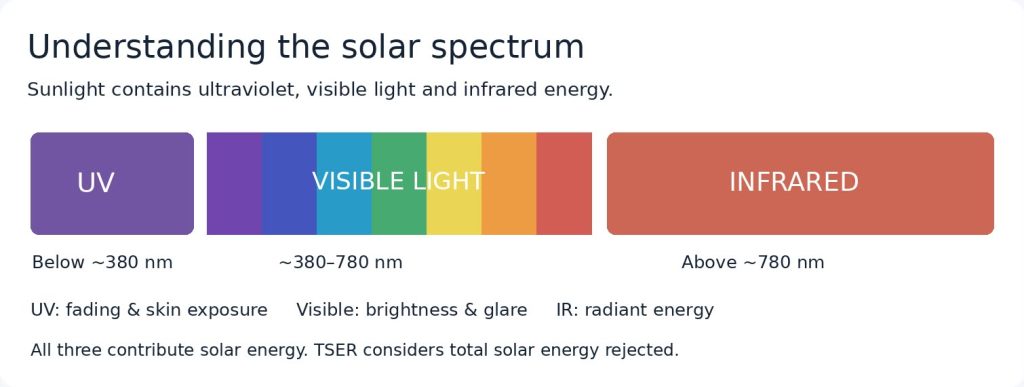
The solar energy reaching your vehicle is made up of approximately:
- 3–5% ultraviolet (UV): A relatively small proportion of solar energy, but important when considering skin protection and interior fading.
- 42–43% visible light: The sunlight we see, which also contributes to heating your vehicle.
- 52–55% infrared (IR): Invisible radiation responsible for a substantial proportion of solar heating.
These are approximate proportions and vary with atmospheric conditions and the solar spectrum being considered.
The important point is that infrared is not the only component of sunlight that contributes to heat.
This is why a window tint’s infrared rejection percentage alone doesn’t tell the full story.
2. What is TSER in window tint?
TSER stands for Total Solar Energy Rejected.
It measures the percentage of total incoming solar energy prevented from entering through a tested glass-and-film combination as heat.
Unlike infrared rejection, TSER accounts for the entire solar spectrum, including ultraviolet, visible light and infrared radiation.
For example, if a glass-and-film combination has a TSER rating of 60%, approximately 60% of incoming solar energy is rejected under the specified testing conditions.
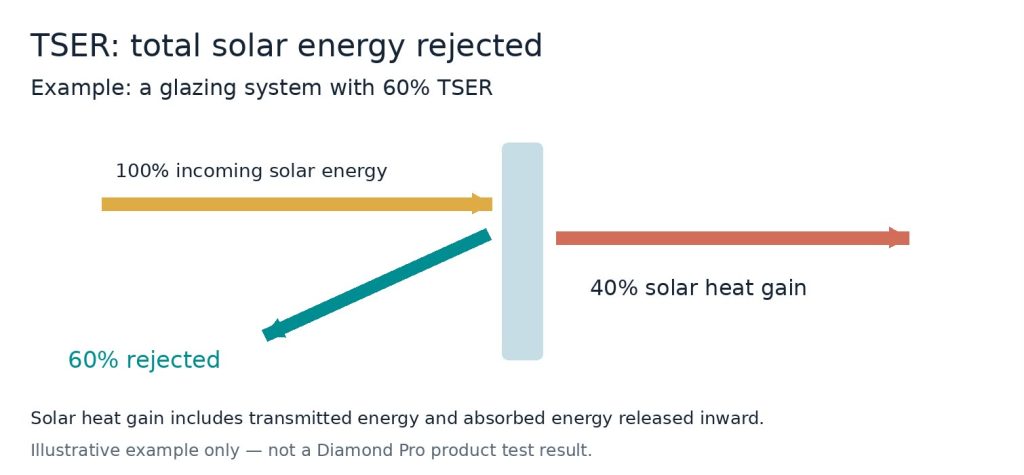
Example: What 60% TSER means
- Incoming solar energy: 100%
- Total solar energy rejected: 60%
- Remaining solar heat gain: 40%
Illustrative example, not a Diamond Pro product test result. Actual TSER depends on the glass and testing conditions.
Why is TSER so important?
Because it provides a more complete picture of solar heat rejection than looking at infrared performance alone.
When comparing two window films, TSER is generally one of the most useful figures to consider, provided both products have been measured using comparable testing methods and glass.
3. What does infrared (IR) rejection mean?
Infrared radiation is invisible to the human eye but contributes significantly to the sun’s heating effect.
Window tint manufacturers frequently advertise infrared rejection percentages of 95%, 98% or even 99%.
These numbers may be accurate, but there’s an important detail that isn’t always explained.
Not all infrared rejection figures are measured across the same wavelengths.
Some measurements focus on a single wavelength, such as 950 nm or 1400 nm, while others evaluate performance across a broader range of infrared radiation.
A window film might reject 99% of infrared radiation at one particular wavelength but perform differently across the rest of the infrared spectrum.
Why does the infrared testing range matter?
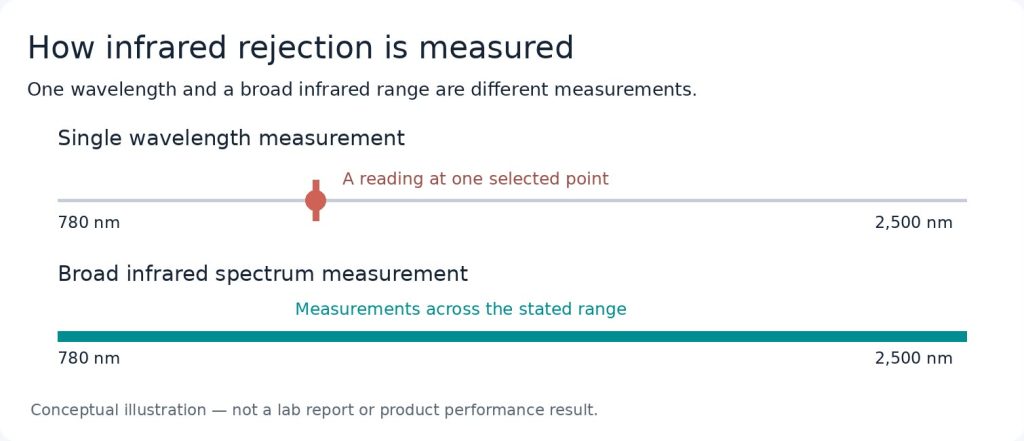
Testing across a broad infrared wavelength range provides a more representative picture of infrared performance than relying on one selected wavelength.
For the most meaningful comparison, broad-spectrum measurements should account for how solar energy is distributed across the infrared spectrum.
This is why consumers should be cautious when comparing infrared rejection figures from different manufacturers.
Does 99% IR rejection mean 99% heat rejection?
No.
A film advertising 99% infrared rejection does not necessarily block 99% of the sun’s total heat energy.
Infrared radiation is only one part of the solar spectrum. Visible light and ultraviolet radiation also carry energy.
This is precisely why TSER is such a useful measurement.
4. What does UV rejection mean?
UV stands for ultraviolet radiation.
Although UV represents a relatively small proportion of solar energy, it is important because prolonged exposure can contribute to skin damage and the deterioration of vehicle interiors.
High-quality automotive window films commonly offer UV rejection of 99% or more within a specified wavelength range.
This helps reduce UV exposure and protects interior materials against fading and deterioration.
However, 99% UV rejection does not mean 99% heat rejection.
UV protection and heat rejection are two different performance characteristics.
5. What is VLT, and does darker tint mean better heat rejection?
VLT stands for Visible Light Transmission.
It measures how much visible light passes through a film or glass-and-film combination.
For example:
- 70% VLT: Allows a relatively high amount of visible light through.
- 50% VLT: Allows approximately half of visible light through.
- 20% VLT: Produces a noticeably darker appearance.
- 5% VLT: Creates a very dark appearance.
A common misconception is that the darker the window tint, the better its heat rejection.
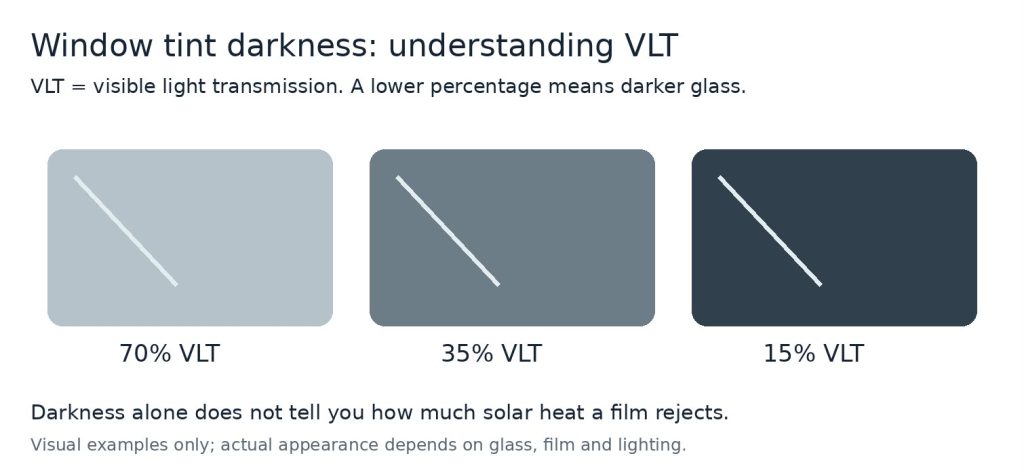
While darker films can reduce solar energy transmission by blocking more visible light, darkness alone doesn’t determine overall heat rejection performance.
A lighter, high-performance window film can sometimes reject more total solar energy than a darker film using less advanced solar-control technology.
The best window tint is not necessarily the darkest.
It’s the film that offers the right balance of heat rejection, visibility, UV protection and appearance.
Always check the window tint regulations applicable in your country.
6. Is ceramic window tint better?
Ceramic window tint uses specialised materials and coating technologies designed to manage solar energy transmission while maintaining optical clarity.
High-quality ceramic films can offer excellent infrared rejection, UV protection and heat reduction.
However, the term ceramic alone doesn’t guarantee superior performance.
Different ceramic films can have very different specifications.
When comparing products, look at their published TSER, VLT and infrared rejection measurements rather than relying entirely on the technology name.
7. How should you compare window tint specifications?
When comparing window films, focus on four important measurements:
- TSER – Total Solar Energy Rejected: How much total solar energy is rejected.
- IR – Infrared Rejection: How much infrared radiation is rejected within the measured wavelength range.
- UV – Ultraviolet Rejection: How much ultraviolet radiation is blocked.
- VLT – Visible Light Transmission: How much visible light passes through the film.
Ideally, compare products with similar VLT ratings, using equivalent testing conditions.
A film advertising 98% infrared rejection is not automatically better at reducing overall solar heat gain than one advertising 90%.
The infrared wavelength range and total solar energy rejection are also important.
8. What makes a good window tint for the UAE and GCC?
The Middle East presents particularly demanding conditions for automotive window films.
In countries such as the UAE, Qatar, Saudi Arabia, Kuwait, Bahrain and Oman, vehicles are regularly exposed to intense sunlight and high ambient temperatures.
When choosing window tint for these conditions, consider:
Solar heat rejection: Look for strong TSER performance to help reduce incoming solar heat.
UV protection: High UV rejection helps protect passengers and vehicle interiors.
Optical clarity: Good visibility is essential, particularly when driving at night.
Durability: Choose a quality film designed for long-term exposure to heat and sunlight.
Professional installation: Correct application is essential for appearance and durability.
Window tint can significantly reduce solar heat gain, but it cannot prevent a parked vehicle from becoming extremely hot.
9. The Diamond Pro Films approach to window tint
At Diamond Pro Films, we believe window tint performance should be explained clearly, accurately and without misleading comparisons.
We believe infrared rejection should ideally be evaluated across the relevant solar infrared spectrum rather than relying on one favourable wavelength to produce an impressive marketing percentage.
That is an important distinction when assessing any manufacturer’s claims.
Our published Diamond Pro Nano Ceramic Window Tint specifications identify infrared rejection at 950 nm and 1400 nm separately. These are wavelength-specific measurements and should not be confused with a verified full-spectrum infrared rejection percentage.
We also publish TSER figures so customers can consider overall solar energy rejection rather than focusing only on infrared performance.
Our Nano Ceramic Window Tint range offers a selection of visible light transmission levels, with published TSER values ranging from 50% to 75%, depending on the product.
These are manufacturer-published specifications, not independently verified results.
Explore Diamond Pro Nano Ceramic Window Tint:
Frequently Asked Questions
What is the best way to compare window tint heat rejection?
TSER is generally one of the most useful figures because it accounts for total solar energy rejection, rather than infrared radiation alone. Compare results measured under equivalent conditions.
Does 99% IR rejection mean 99% heat rejection?
No. Infrared rejection refers to infrared radiation within a specified wavelength or range. It does not represent total solar heat rejection.
Is darker window tint better at rejecting heat?
Not necessarily. Advanced lighter films can sometimes reject more total solar energy than darker films with lower solar-control performance.
What is the difference between TSER and UV rejection?
TSER measures total solar energy rejected. UV rejection measures how much ultraviolet radiation is blocked.
Does ceramic window tint reduce heat?
Yes, quality ceramic window films can reduce solar heat gain. Their actual effectiveness depends on the film’s performance specifications.
Can window tint keep my car cooler in Dubai or Qatar?
Window tint can reduce the amount of solar heat entering through the glass, helping improve comfort. However, it cannot eliminate heat buildup or replace air conditioning.
Final Thoughts: Look Beyond the Biggest Percentage
When choosing automotive window tint, don’t be influenced by one impressive number.
A 99% infrared rejection claim might sound excellent, but without knowing how it was measured, it doesn’t tell you everything about the film’s heat rejection performance.
Understanding TSER, IR, UV and VLT allows you to make a more informed decision.
At Diamond Pro Films, we believe better information leads to better choices.
For more information about our window film range, visit:
Diamond Pro Films: https://diamondprofilms.com/
Diamond Pro Nano Ceramic Window Tint: https://diamondprofilms.com/diamond-pro-nano-ceramic-window-tint